Offer Ends In
00
:
00
:
00
:
00
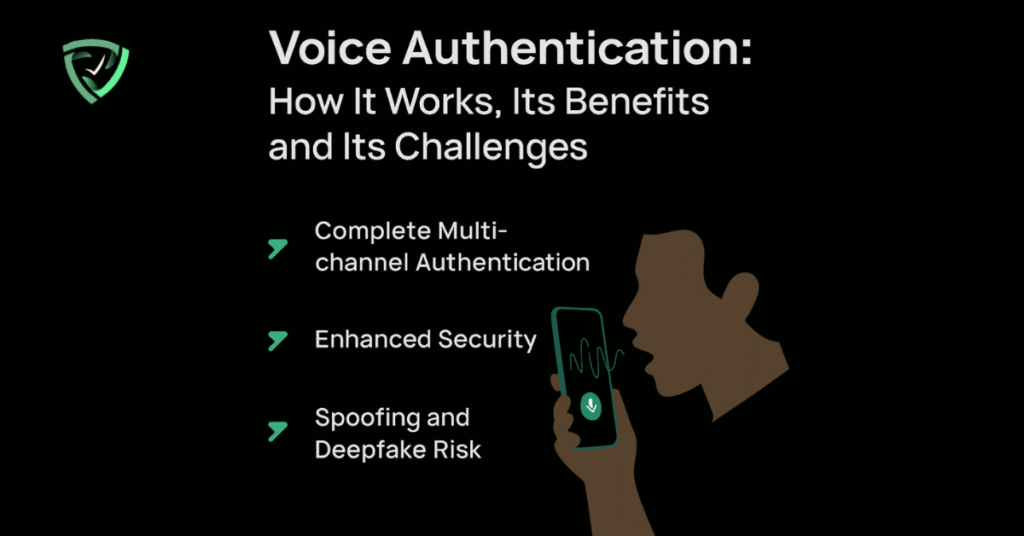
Voice authentication has rapidly emerged as a reliable way to verify identities in online apps and smart devices, simply through people’s unique voices. This technology combines biometrics with AI-driven precision, creating a secure and seamless experience across various devices and industries.
In this article, we’ll explore what voice authentication is, how it works, its key benefits and limitations, and how you can implement it easily through Authentica, a leader in digital identity solutions.
Voice authentication, also called voice verification, is a type of biometric authentication that uses a person’s unique vocal characteristics to confirm their identity. Just as fingerprints or facial features can serve as identifiers, a person’s voice offers distinctive physiological and behavioral traits that are difficult to replicate.
When a user first enrolls in a system, their voice is recorded through a first time setting process known as voice enrollment. This involves capturing multiple samples of speech to form a reference model, which is often called a voiceprint or more professionally, enrollment template. Once these samples are stored securely, this template becomes the base for verification whenever it is needed.
During authentication, the system compares a new sample of the user’s voice against the stored template. Advanced algorithms analyze multiple vocal features, such as tone, pitch, cadence, and pronunciation, to determine if both samples match.
There are two primary types of voice authentication:
Voice authentication can be deployed across a range of applications including mobile banking, call centers, web platforms, and IoT devices, offering flexible, hands-free verification wherever needed.
Voice authentication’s wide implementation is because of its balance of security, simplicity and scalability. Businesses across industries are trusting it as a tool to strengthen customer trust while making interactions faster and more seamless. These are some of the benefits of voice authentication technology:
Unlike passwords or PINs that can be stolen, voice biometrics are tied to the user’s unique biological identity. Every human voice is shaped by over 70 unique physiological factors, from vocal cord length to sinus cavity shape, making it highly resistant to duplication.
When combined with liveness detection and device-based verification, voice authentication offers multi-factor security that effectively mitigates risks of widely used attacks like phishing and social engineering.
Voice authentication removes the burden of remembering complex passwords or verifying through multiple manual steps. A quick spoken phrase or even a short conversation can authenticate the user without hassle, creating a smoother experience that boosts satisfaction.
In call centers, verifying customers traditionally requires agents to ask multiple security questions, a process that consumes time and increases costs. With voice authentication, the system can identify callers automatically, cutting down Average Handle Time (AHT) and freeing agents to focus on resolving issues rather than verifying identity.
Because voice authentication is contactless, it offers accessibility advantages for users who may find other authentication methods harder to use. It also minimizes physical contact, a benefit that became especially relevant during the COVID-19 pandemic.
While voice authentication brings clear advantages, it doesn't come without challenges. Businesses adopting this technology should understand its potential limitations to design a balanced security approach:
Voiceprints, like any digital data, must be stored securely. If breached, unlike passwords, a compromised voice cannot simply be “reset.” Therefore, strong encryption and secure storage practices are essential.
Background noise or poor audio quality can reduce accuracy. Environments like busy offices or public areas may not always be ideal for voice verification, requiring additional backup options.
A cold, sore throat, or even emotional stress can alter vocal tone enough to affect verification accuracy. While advanced systems can tolerate minor variations, extreme cases may require alternative authentication methods.
Modern voice technologies can imitate speech patterns with incredible precision . However, top-tier systems now integrate anti-spoofing AI and liveness detection to identify synthetic or replayed voices. Maintaining this technological edge requires constant updates and testing.
For organizations aiming to integrate voice authentication without building everything from scratch, which can be hard or time-consuming especially with such technology needing continuous updates in the era of AI, Authentica offers a streamlined solution.
Authentica provides AI-driven biometric identity authentication API, allowing businesses to deploy these technologies with no coding or development and with guaranteed updates and a pay as you go pricing model. You can learn more at authentica.sa or leave questions here.
Voice authentication is no longer futuristic, it’s practical, scalable and already shaping how users access services securely. By using a reliable technology that addresses challenges like spoofing and inaccuracy, a great user experience and security balance can be provided.