Offer Ends In
00
:
00
:
00
:
00
Authentication has always needed a balance between security and convenience. Users want to access accounts quickly, while businesses need to protect every login from the many digital risks and possible attacks.
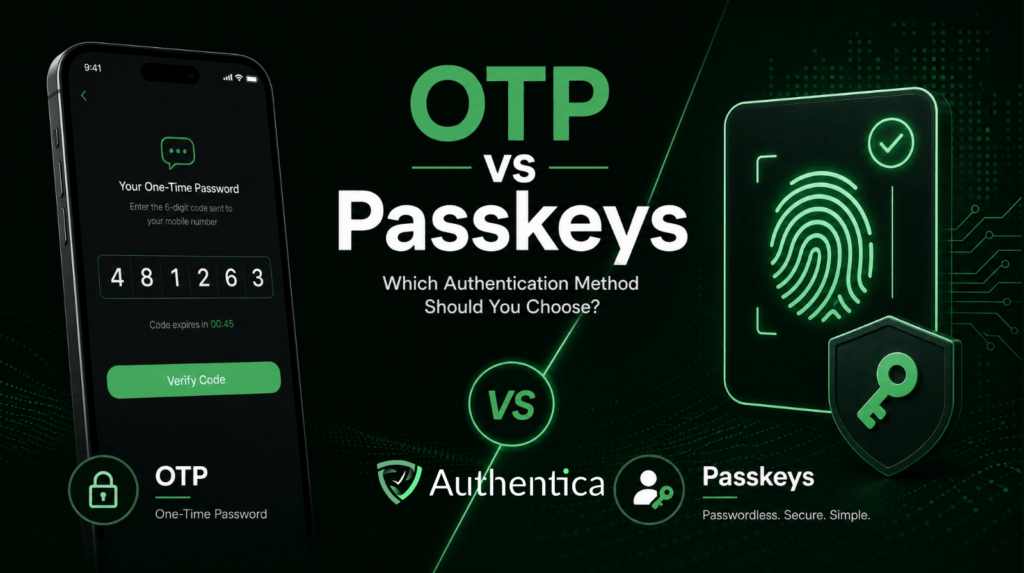
For years, One-Time Passwords (OTPs) were a common way to add a second layer of protection while authenticating users. However, as they are being replaced by passkeys, we compare OTP vs Passkeys and the advantages of each.
Through this method, a user receives a temporary code through SMS, email or an authenticator app, enters it, and login is completed when the right code is entered.
However, attackers have become better at stealing accounts using this method, with techniques like phishing, SIM swapping and social engineering attacks. OTPs also have some user experience flaws as they can get delayed or never arrive. This is why passkeys are becoming a serious alternative, offering stronger security and making login easier for users.
Passkeys are among passwordless authentication methods based on public key cryptography. Instead of asking the user to type a password or enter a temporary code, the system lets the user’s device prove their identity automatically through a stored cryptographic key.
When a passkey is created, the device generates two keys. The public key is stored by the service, while the private key remains securely on the user’s device. During login, the service sends a challenge, and the device signs it using the private key. If the signature is valid, access is granted.
For the user, this usually feels like unlocking a phone. They approve the login with a fingerprint, face recognition, PIN or screen lock. Behind the scenes, the system performs a cryptographic check quickly without showing anything.
Security is where the difference becomes clear. OTPs improve security compared to using passwords alone, but they aren't still more vulnerable compared to more advanced authentication methods.
SMS OTPs are vulnerable to SIM swapping, where attackers convince the telecom provider to move the victim’s number to another SIM card. Email OTPs depend entirely on the security of the email provider. Authenticator app OTPs reduce some risks, but they can still be phished through fake login pages.
Passkeys offer better security and less risk because they are bound to the legitimate website or application. A phishing website cannot trigger a valid passkey response for another domain. The private passkey also never leaves the device, which means attackers cannot capture or intercept it the same way as passwords or OTPs.
OTPs are familiar, but they add a bit of avoidable hassle into the login process. Users need to wait for the code, switch between apps, type it correctly and complete the process before it expires. If the code is delayed, goes to spam, or is entered incorrectly, the login experience becomes frustrating.
Passkeys, on the other side, create a smoother experience. The user approves access instantly with no movement between apps or a hassle of doing something wrong.
OTP can still be useful for phone number verification, signup confirmation, low-risk account recovery and as a temporary fallback authentication method. It can also still be preferred by a large number of users who are used to it.
However, OTP should not be the sole authentication method, especially for high-risk accounts. If your platform handles payments, sensitive data, admin access, or financial transactions, then OTP alone is not enough.
Passkeys are the better choice when security and user experience both matter. They are ideal for most platforms and offer less risk. However, they still need careful planning. Organizations must consider device support, browser compatibility, account recovery process, synced passkeys and shared-device scenarios.
Yet with growing support from major operating systems, browsers and password managers, passkeys are becoming more practical for everyday use.
The comparison between OTP and passkeys shows how authentication is evolving. OTPs helped businesses move beyond passwords alone, but they were never a perfect solution. Passkeys offer a better and more secure alternative that you can begin shifting to gradually, especially with it enhancing user experience. So Authentica offer SMS OTP.